
Il-76: Why the Heavy Airifter Features a Glass Nose, Twin Cabins, and a Cargo Ramp
In this article, we look inside the design of the Soviet Il-76 heavy airlifter: why it features a glazed nose and a separate navigator's cabin, how its cargo ramp operates, why its multi-wheel landing gear enables unpaved and snow runway operations, and why the aircraft remains irreplaceable to this day.

The Il-76 is easy to recognize on any ramp: a tall T-tail, four wing-mounted engines on pylons, an upswept rear fuselage with a cargo ramp, and a distinctive multi-wheel landing gear that retracts into large fairings on the sides of the fuselage. This heavy transport aircraft has been flying since the mid-1970s, and over the course of half a century, it became the primary workhorse of military transport aviation, first for the USSR, and subsequently for Russia and two dozen other nations.
Over this period, generations of passenger airliners have come and gone, yet the Il-76 continues to haul military hardware, paratroopers, and cargo to destinations where other aircraft simply cannot land. The secret to its longevity lies in the fact that the aircraft was originally designed for operating environments that Western airlifters are not configured to handle. Let's break down how the Il-76 is built, why it features such a ramp and landing gear configuration, and why there is still no replacement for it.
Why Such an Aircraft Was Needed
By the late 1960s, the Soviet Union required a next-generation heavy transport aircraft. The existing turboprop An-12 was no longer sufficient: it carried only about 20 tons and lacked the required range and speed, while the military needed to deploy heavy equipment and paratroopers across the vast country—often to poorly prepared airfields.
The task was assigned to the Ilyushin Design Bureau. The aircraft was designed as a jet powered by four engines, configured to transport up to 40 tons of cargo over several thousand kilometers. The Il-76 made its maiden flight in 1971, and in 1976, the aircraft entered active service. The core requirement embedded into the design from the very outset defined the aircraft's entire configuration: it had to be capable of landing not just on concrete runways, but also on unpaved, ice, and snow-covered airfields completely lacking airfield infrastructure.

Design: High-Wing Configuration and Cargo Hold
The layout of the Il-76 is dictated by a single mission—carrying outsized cargo and executing rapid loading and unloading operations. The wing is positioned on top of the fuselage in a high-wing configuration. This design choice is deliberate: with a high wing, the cargo hold occupies the entire volume of the fuselage from floor to ceiling without interruption from the wing center section, and the floor itself remains low to the ground, simplifying loading operations.
The engines are mounted on pylons forward and below the wing—four turbofans, which on newer variants are the PS-90A-76. Four engines instead of two provide not only the necessary thrust for a heavy aircraft but also a margin of safety: at an unpaved airfield far from main bases, reliability is more critical than fuel economy, and losing one out of four engines is not critical for the Il-76.
The cargo cabin is a pressurized compartment approximately 20 meters long, with a width and height of 3.4 meters. It accommodates military hardware that a standard aircraft cannot accept: armored personnel carriers, trucks, engineering vehicles, and shipping containers. Overhead cranes, hoists, and floor rails run along the compartment, enabling the crew to load and manipulate cargo independently, without relying on ground support equipment. This again emphasizes autonomy: the aircraft arrives at an unequipped site and must unload itself.
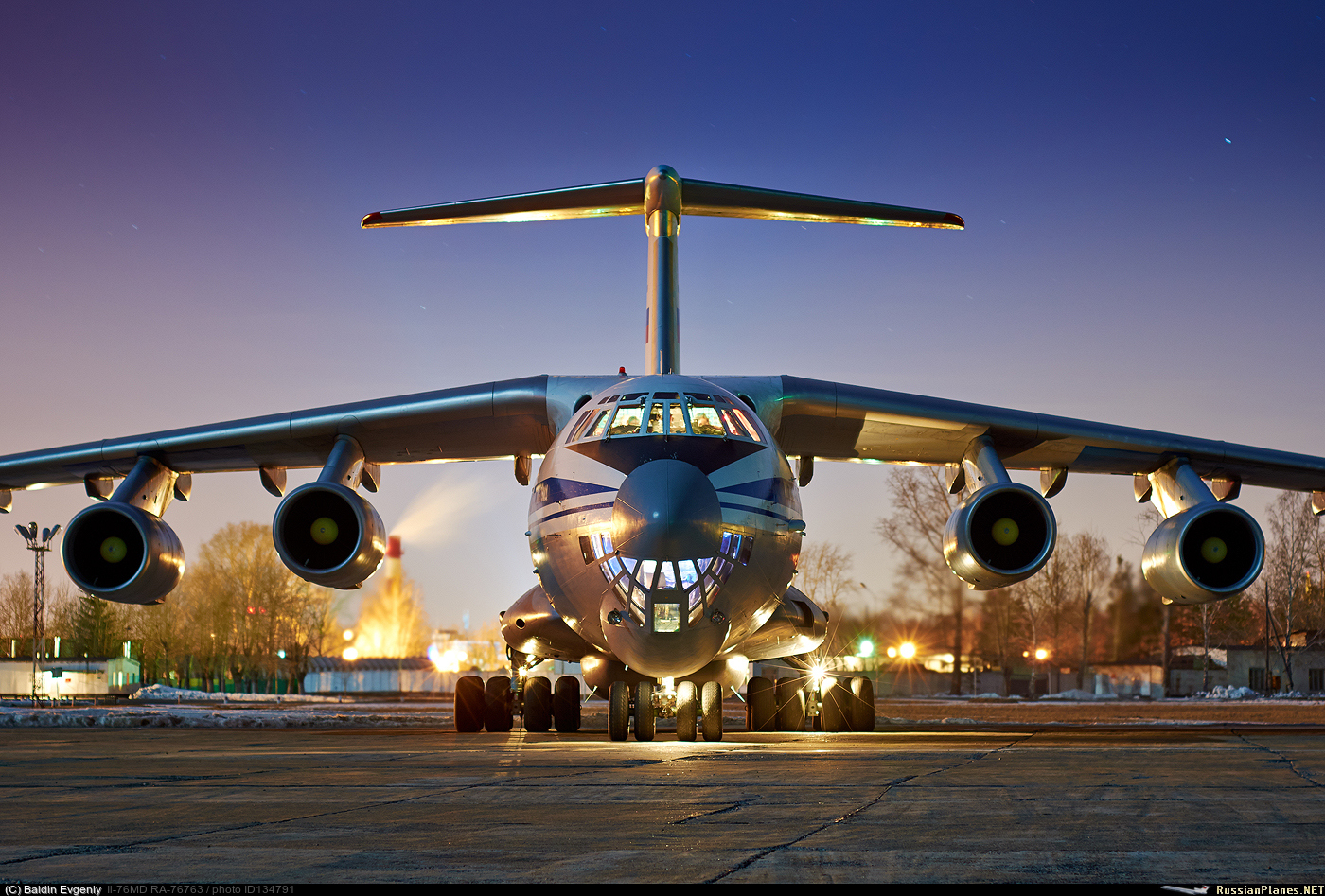
Glass Nose and Twin Cabins: Why the Il-76 Looks Exactly Like This
The most recognizable feature of the Il-76 is its nose. Unlike passenger airliners that feature a solid radome nose cone, the nose section of the Il-76 is extensively glazed, and a second, separate glass station sits directly beneath the main flight deck. Due to this glazing and its distinct shape, the aircraft's nose is often described as a "smiling face"—and the resemblance is indeed there.
The lower cabin is the navigator's station. Through this glazing, the navigator views the ground directly beneath and ahead of the aircraft; this is not an archaism, but a operational necessity for a military transport aircraft. During low-altitude paradrops, cargo extractions onto unprepared drop zones, and approaches to unpaved airfields lacking precision ground-based navigation aids, it is visual contact with the terrain that allows the aircraft to be guided precisely to the target point. Consequently, the navigator is positioned below, in the nose, with a maximized forward-and-downward field of view.
This results in a two-tier nose layout: the pilots' cockpit on top, and the navigator's cabin below. On newer variants equipped with modern glass cockpits, the dependence on the navigator's glazing has decreased—satellite navigation and digital flight management systems handle a portion of these duties—but the characteristic glazed nose remains a signature feature of the entire Il-76 family.
The Cargo Ramp: The Defining Feature
The aft fuselage of the Il-76 is swept upward, a configuration dictated by the cargo ramp—a wide, deployable aft ramp used for loading vehicles and equipment. The tail is elevated so that when the ramp lowers to the ground, it forms a shallow approach angle, allowing rolling stock to drive into the cargo hold under its own power.
The ramp operates in several configurations. Lowered to the ground, it acts as an inclined ramp: trucks and armored vehicles drive directly up it into the aircraft. Raised to the height of a truck bed, it permits direct vehicle-to-aircraft cargo cross-docking. In flight, the ramp serves as a paradrop door—cargo platforms on extraction parachutes and paratroopers are deployed through the open rear aperture. The capability to air-drop equipment and personnel in flight without landing is a core mission function of a military airlifter, and the Il-76's ramp system is engineered precisely for this purpose.

Landing Gear Engineered for Dirt and Snow
The most unusual design feature to a civilian eye is the Il-76's landing gear. Instead of the conventional twin-wheel struts found beneath heavy commercial airliners, the Il-76 employs a multi-wheel landing gear assembly: the main landing gear units feature multiple wheels of relatively small diameter, retracting into aerodynamic fairings along the sides of the fuselage.
The engineering objective behind this arrangement is to distribute the aircraft's gross weight over a large footprint area. By maximizing the number of wheels and maintaining low tire pressure, the aircraft minimizes its ground contact footprint pressure. This allows the Il-76 to land on unpaved surfaces, sand, compacted snow, and ice, where an aircraft with conventional landing gear would either bog down or destroy the surface. Tire pressure can be adjusted directly in flight, adapting it to the specific runway surface type prior to landing: one setting for concrete, another for soft ground.
The high ground clearance of the fuselage also serves this operational goal. The engines are positioned high above the ground to prevent foreign object damage (FOD) from stones and mud on unpaved runways, while the lower contours of the fuselage avoid striking terrain irregularities. Taken together, these features turn the Il-76 into an aircraft that does not require an airfield in the conventional sense—a level clearing of appropriate length is sufficient.
Modifications: From Transport to Flying Radar
Over fifty years, more than two dozen modifications have been built on the Il-76 airframe, and many of them do not haul cargo. The core transport lineage evolved through the Il-76M and Il-76MD variants, which featured increased payload capacity and range, followed by the stretched Il-76MF.
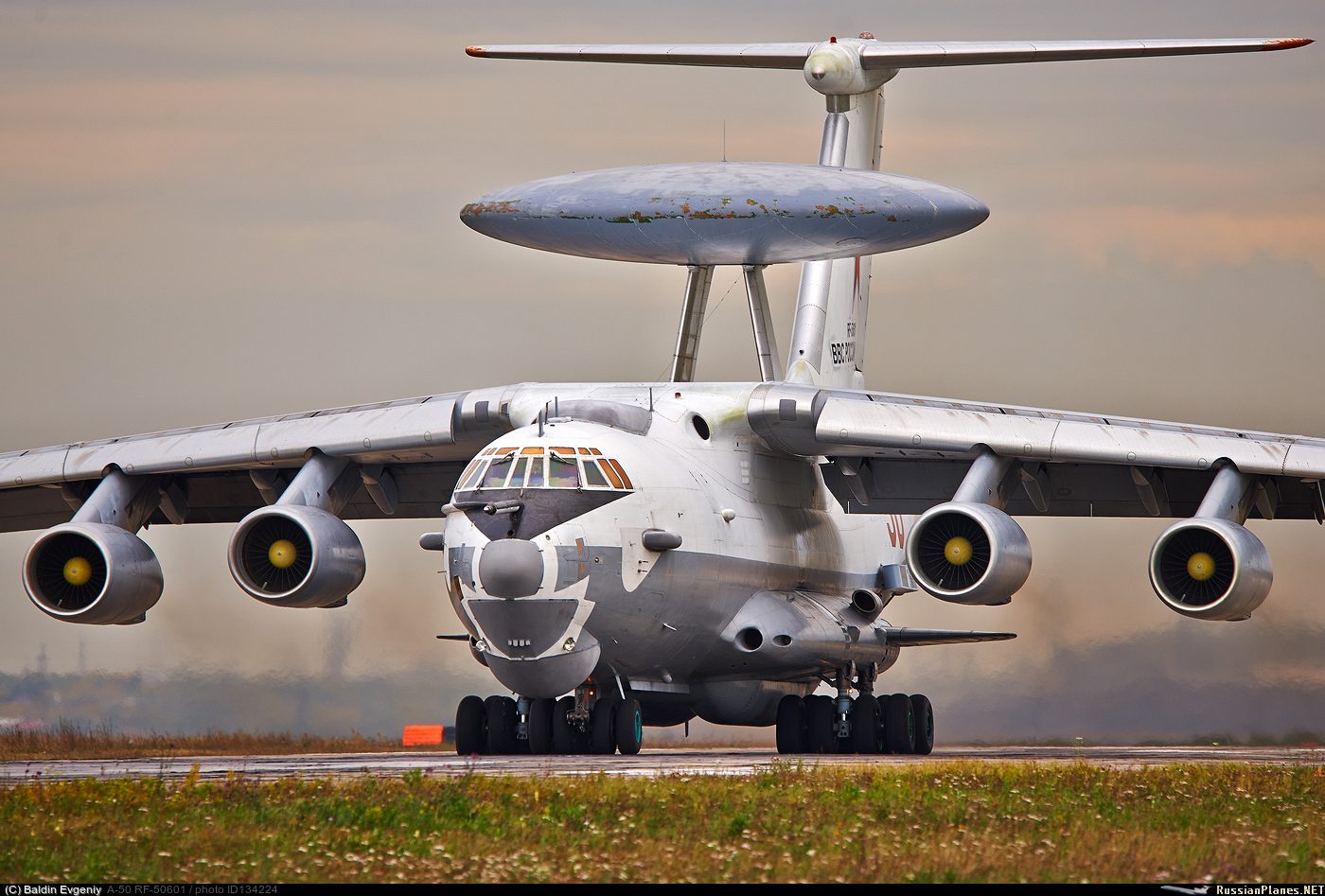
An entire family of special-mission aircraft was developed around the same airframe. The Il-78 is an aerial refueling tanker: instead of cargo, it carries internal fuel tanks and hose-and-drogue refueling pods to refuel other aircraft in flight. The A-50 is an Airborne Early Warning and Control (AEW&C) aircraft, instantly recognizable by the massive rotodome radar antenna mounted above the fuselage; it serves as a flying radar post controlling tactical air operations. Firefighting variants capable of dropping dozens of tons of water, airborne command posts, and flying laboratories also exist. The versatility of an airframe designed for high volume and heavy structural loads allowed it to be adapted to widely diverse mission profiles.
Il-76MD-90A: The Next Generation
For many years, the Il-76 was manufactured in Tashkent, located in Uzbekistan. Following the dissolution of the USSR, this arrangement turned into a strategic problem: production of a heavy airlifter for the Russian military was now located outside its borders. In 2006, the decision was made to relocate production to Russia, specifically to the Aviastar-SP aviation plant in Ulyanovsk, while simultaneously subjecting the airframe to a deep modernization program.
This effort produced the Il-76MD-90A, also known during development as "Izdeliye 476." Externally, it looks nearly identical to the classic Il-76, but technically, it is a largely new aircraft. It received more powerful and fuel-efficient PS-90A-76 engines, a redesigned wing, reinforced landing gear, and a modern glass cockpit featuring digital avionics instead of the old analog instrumentation. Payload capacity increased to 60 tons. The modernized aircraft performed its maiden flight in 2012, and the Il-76MD-90A is currently the primary serial production version being built for Russian military transport aviation.
Relocating production resolved a strategic objective: Russia re-established a complete domestic manufacturing cycle for its heavy airlifter, independent of foreign suppliers. This in itself explains why, rather than developing a completely clean-sheet aircraft design, the decision was made to modernize a proven, half-century-old airframe configuration—it works, operators know it, and upgrading it to modern standards is faster and more cost-effective than starting from scratch.
Why It Remains Irreplaceable
The Il-76 occupies a highly specific payload niche. It carries up to 50–60 tons—more than the European Airbus A400M military transport with its roughly 37-ton capacity, but less than the American Boeing C-17 heavy airlifter with its 77-ton limit. In this intermediate class, the Il-76 has virtually no alternatives: few aircraft of this category are produced worldwide, and even fewer possess its rough-field operational capabilities.
It is precisely this airfield-agnostic ruggedness that keeps the Il-76 in service. Most heavy airlifters require high-quality concrete runways, whereas the Il-76 lands where no paved runways exist at all. For a country with a vast territory, a significant portion of which consists of the Far North, Siberia, and areas lacking a developed airfield network, this is a decisive operational capability. Delivering heavy machinery, fuel, or emergency responders to a destination accessible only via a compacted dirt track or an ice runway is a mission that almost no aircraft other than the Il-76 can perform.
Compounding this is the simple operational inertia of a large active fleet. Around one thousand Il-76 airframes have been built, and an entire ecosystem of maintenance infrastructure, aircrew training pipelines, and spare parts supply lines is structured around it, while pilots and technicians know the aircraft inside out. Replacing such an aircraft would require not just manufacturing a new airframe, but overhauling an entire global infrastructure network—and as long as the modernized Il-76MD-90A fulfills current operational requirements, doing so remains unnecessary. A half-century-old design remains on the flight line not for lack of options, but because it executes its mission in a manner that almost no other aircraft can match.